

🛒The Check-Out: Cora Purdy, SURI
Cora's background, 3 big lessons she's learned, and the road to circularity
What’s one way to share and learn from each other in the sustainability profession? A sneak peak behind the scenes of course! This week we feature a wonderful guest writer, Cora, who is the Sustainability Manager at SURI.
Keep scrolling to discover:
The career path that led Cora to SURI
What we can learn from SURI’s take back scheme
Our Weekly Good(s) News roundup!
> Guest Writer - Cora Purdy

I spend a genuinely embarrassing amount of my working life thinking about used toothbrush heads. That one sentence probably tells you most of what you need to know about a career in sustainability: rarely glamorous, almost never tidy, and absolutely nothing like the brochure. But I wouldn’t swap it. So here’s how I fell or rather, walked surprisingly straight, into it, and a few of the honest, unglamorous lessons that have stuck along the way. Kettle on?
So, how did I end up at SURI?
Most people in the sustainability sector will likely tell you they fell into it — they arrive as a transition from somewhere else (finance, fashion, engineering) and find their way in sideways. During my A-levels I hadn’t a clue what I wanted to do. At one point I wanted to be a volcanologist; then I very nearly ended up studying food science at uni, before I realised there was a bit too much chemistry and physics involved and switched to environmental science. Ironically, I took maths, chemistry and physics in my first year there anyway…
Environmental science at the University of Leeds nearly ten years ago, a placement year at a paper mill in Kent that I went back to after graduating, two years out travelling, a stint in consultancy, and now a sustainability manager at SURI. So my route into sustainability was, ironically, almost completely linear compared to the usual career zig zag.
What does sustainability actually look like in real life?
Nothing like the textbook, it turns out. My placement year and then my first proper job, was at DS Smith in Kemsley, the biggest recycled paper site in the UK, and the role was essentially one enormous balancing act. Picture a 20-something Northern Irish girl with a funny accent, a clipboard, steelies and a hi-vis, trying to tell 40-year-old engineers there might be a better way to do the thing they’d done for decades. Resilience: acquired. The grade of paper on the machine changed the water intake, which changed what the effluent plant had to cope with, which competed for the same steam the machines needed to run — move one lever and three others twitched. That’s the part they don’t teach you: real-life sustainability is rarely a tidy strategy; it’s a constant negotiation between systems that all lean on each other. I came back after uni as Environmental and Waste Coordinator — suddenly responsible for the emissions of a closed landfill and a lagoon classed as a reservoir, which wasn’t exactly on my 2021 bucket list, but there we are. I learnt more about environmental compliance than any degree ever could.
Three big lessons I’ve learnt at SURI
Fast-forward to 2025, I joined SURI covering the amazing Sarah Yu‘s maternity leave and never left. A year and a bit in-house has taught me more than I expected. I’ve had to narrow this list down a lot, every day at SURI is a school day — but here are three lessons that have stuck.
1️⃣ In-house vs consultancy
After I came back from Southeast Asia and Australia, I did a brief stint as a sustainability consultant. Over a handful of months I worked with wildly different businesses: agri-food producers, luxury hotels, a transport firm, mostly helping them chase B Corp certification. Consulting is a bit like being a tourist: you arrive with fresh eyes, you get to focus on one thing and give it your whole attention, and you leave them with a clear plan. It’s a real skill, and I loved it but you only ever see a business for a finite window, on its best behaviour.
Going in-house is moving in. That same “obvious” fix is suddenly one of a hundred things competing for attention, budget and people’s time, up against a product launch, a retail deadline, a pile of detailed customer queries and whatever caught fire that morning. You can’t just hand over the recommendation and move on; you have to actually make it happen, slowly, in and around everything else, and then live with the result for years. That’s the bit consulting can’t teach you: advising is hard, but owning the messy reality (especially as a team of one) and getting it done amid a hundred other priorities — is harder.
2️⃣ Take-back schemes are humbling
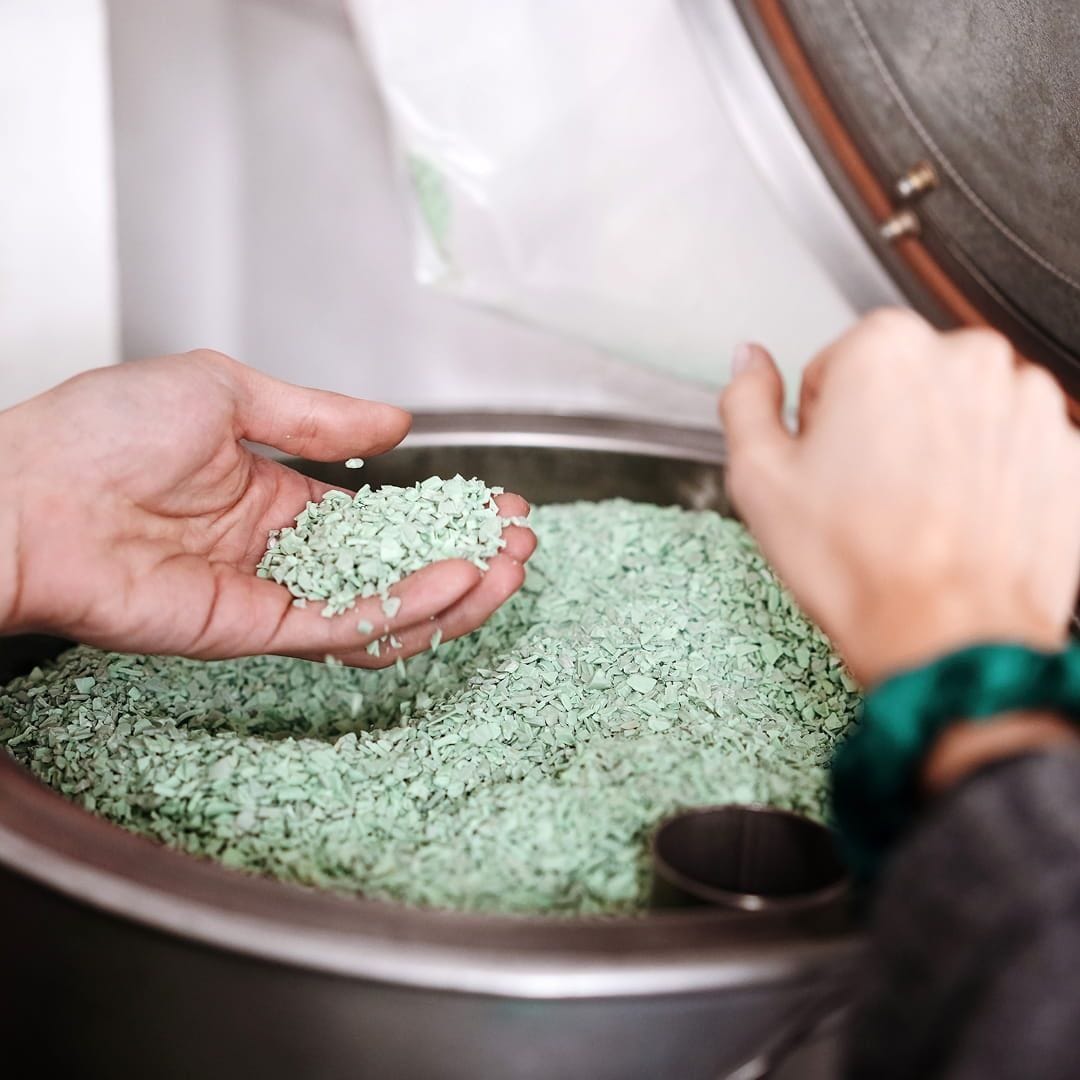
We ask customers to send back their used brush heads so we can give them another life — which sounds lovely until you’re faced with the challenge (or opportunity) of what to do with them. I didn’t have a product background (and could argue I still don’t), so I learnt fast what you can and can’t do with polylactic acid( PLA-bioplastic): it’s fussy, recycled material comes with impurities, and injection-moulding machines have strong opinions about impurities. Normally our product team goes through rounds and rounds of testing, but when we partnered with Reborn to make our soap dishes, we had finite material. It was like gold dust, so when it came to the full production run, we had one go to do it right — and because we wanted behind-the-scenes footage, we had a film crew watching while we did it. Luckily they turned out great ), but I had no nails left by the end of that day.

And getting the heads back at all is its own battle. I’m a huge fan of UpCircle’s products, and I take real comfort from the fact that they ran a Freepost refill scheme for five years. They have been refreshingly honest that, as it grew, so did the headaches — empties returned dirty, smashed or wrapped in yet more plastic, and the whole thing was hard to scale beyond the UK. As SURI expands into more retailers and markets, our neat direct to consumer’s version doesn’t simply copy across. In the UK, if you buy direct, a return mailer bag is added by our 3PL; and if you don’t have one, you can write FREEPOST SURI on an envelope, pop it in a letterbox, and Royal Mail will make sure it finds its way back to us. Anyone who buys a SURI outside DTC — in the US, say — doesn’t have that option, and we know far less about our American customers and what would make them post a used head back to us. How do you build a loop before you know what closes it?
3️⃣ The push and pull of design and end of life
As much as 80% of a product’s environmental impact is locked in at the design phase, according to the European Commission and yet the people designing products and the people who’ll eventually have to recycle them are almost never in the same room. The system rarely keeps up with innovation. Take compostable materials: companies like Notpla (seaweed-based) and Shellworks (grown by microbes) are making genuinely brilliant alternatives to plastic, but run them through the UK’s new Recyclability Assessment Methodology and they’d almost certainly come out red — because biodegradable polymers are automatically rated red, not for being “bad”, but because there’s no stream set up to deal with them yet. Even “obviously recyclable” is slippery: aluminium is deemed infinitely recyclable, but if an aluminium tube goes in the bin still full, scrap-metal recyclers won’t touch it, because the residue contaminates the whole load. So do you design for the system as it is and take the safe option, or back the better material and bet that the more of it enters the system, the harder it becomes for the government to keep ignoring? Do you design for the world we have, or the one we need it to become?
My advice!
I’m under no illusion that I’ve cracked this if anything, I’ve a huge amount left to learn (Material Science 101 still pending).
So if I could leave other sustainability managers with a few hard-won things, they’d be these.
Get the people designing your products in the same room as the people who’ll eventually have to recycle them, literally bring your product team along on the recycling site tour, because half the end-of-life headaches get designed out before they’re ever locked in.
Teach your marketing team about the materials in your products properly, so they can speak to them with real confidence and accuracy rather than reaching for the vague “eco” language that slides into greenwashing.
And, above all, don’t wait until it’s perfect to start. Run the pilot. You’ll learn more from one imperfect, real-world test than from months spent planning a flawless one — and often the recycling stream, the data or the material you were holding out for only shows up once you’ve actually begun. Test small, expect to get a few things wrong, and treat every pilot as a way to learn rather than something that has to succeed.
I’ve just finished Love Story and have been on a bit of a Kennedy deep dive ever since, so I’ll leave you with this, as JFK put it: “Those who dare to fail miserably can achieve greatly.”
Brands I'm loving right now ✨
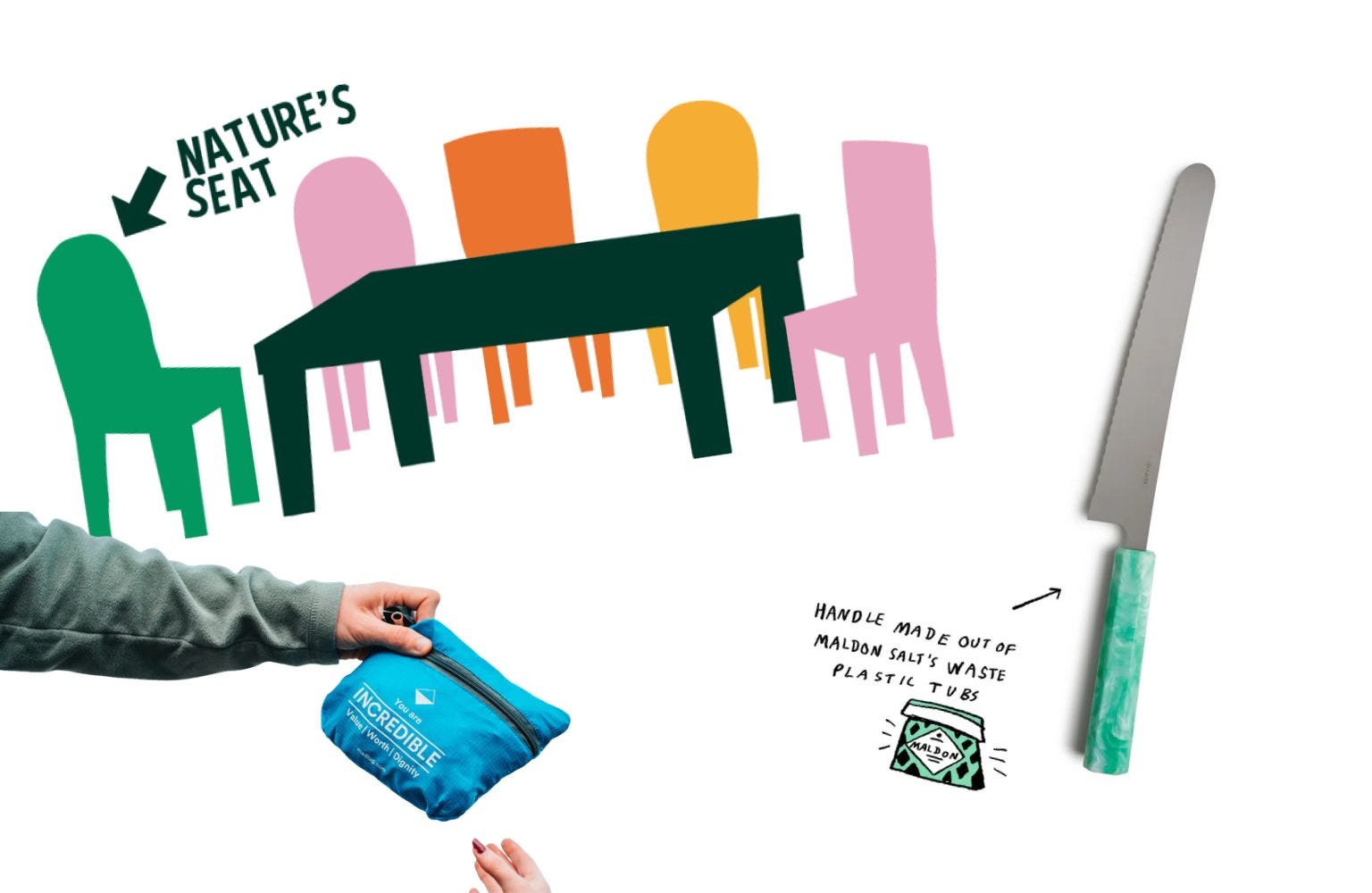
Allday Goods. I will be forever obsessed with their genuinely stunning chef’s knives, with handles cast from 100% waste plastic — Maldon Salt tubs, plant pots, even fishing nets pulled off British beaches. They’ve diverted close to 24 tonnes of plastic from landfill, and no two handles are ever the same.
Faith in Nature. I’m a bit late to the party on this one, but I was listening to Edie’s Sustainability Uncovered podcast last month and found out that in 2023 they did the most quietly radical thing I’ve seen in corporate governance: they appointed Nature itself to their board of directors, giving the natural world a literal voice and vote in company decisions — a world first.
Madlug. Kids in care often move their belongings in black bin bags. Madlug runs on a “buy one, wear one, help one” model: for every bag you buy, a pack-away travel bag goes to a child in care — over 130,000 of them so far.
> Last week in consumer goods x climate…
The Good(s) News
Mei Mei Goods, an Asian condiment brand originating from the Borough Market, has certified as a B Corp 🎉🫙
JUBEL has shared their 2025 impact report, the report has some really clear graphs illustrating the impact of partnering with Wildfarmed as well as sharing that they have achieved a 13% year-on-year reduction in carbon intensity 😃🍑
Zalando has partnered with Vestiaire Collective to bring Vestiaire’s vetted luxury second-hand collection to customers 👜🔁
PR3 | the Global Alliance to Advance Reuse has announced the new symbol to designate reuse infrastructure and packaging that meets very specific criteria. The hope is that a symbol like this will help us recognise systems that have been pretty tricky to scale so far!
Have good news? Share it with us - info@followingthefootprints.com!
Have you got any questions for Cora? Drop them into the comments and we’ll reach out to her to get the inside scoop😊
Until next time!
Team FTF
Adored this, Cora - and very much off to watch Love Story after reading that quote.
What excites you most about your role at the moment - and, about the world?